The Problem – Frequency Stability and Accuracy
The Icom IC9700 uses a Temperature Compensated Crystal Oscillator (TCXO) running at 49.152MHz to generate the frequencies for conversion of the 1296MHz transmitter / receiver to an IF and to provide the frequencies required for the Software Defined Radio (SDR). The TCXO is a small, 2.5 x 2.0 x 1.0 mm L x W x H SMD component. The TCXO is also voltage controlled from the radio’s synchronization functions. This allow manual setting of the frequency of the radio and with later firmware upgrade, allow automatic synchronization to an external 10MHz reference such as the GPSD-2 (https://brisbaneradiosociety.net/10-mhz-reference-by-vk4amg/)
Due to the latency in frequency adjustment with temperature changes in the radio and due to steps noticeable in the automatic synchronization function, digital communication, particularly at 1296MHz may be affected. Without automatic synchronization, the receive waterfall for a digital mode may look like a banana and prevent decoding. Because of the complexity and the SMD construction of the IC9700, it is difficult to sample the TCXO frequency and apply control voltage to provide stable and accurate frequency. The IC9700 automatic synchronization function ensures the TCXO is within injection lock range.
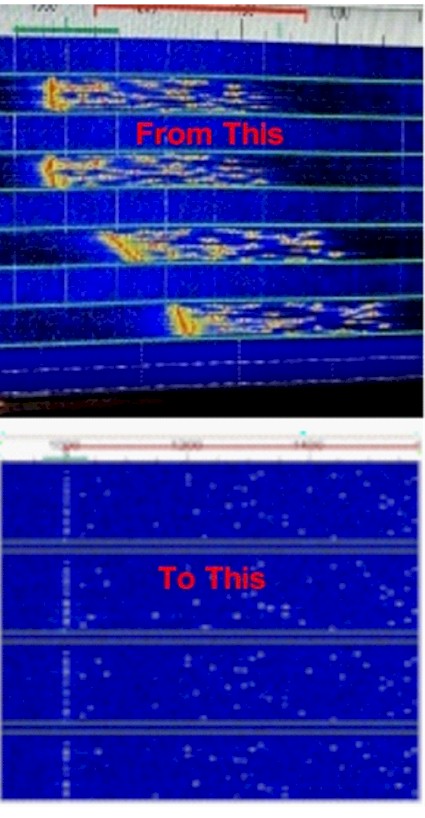
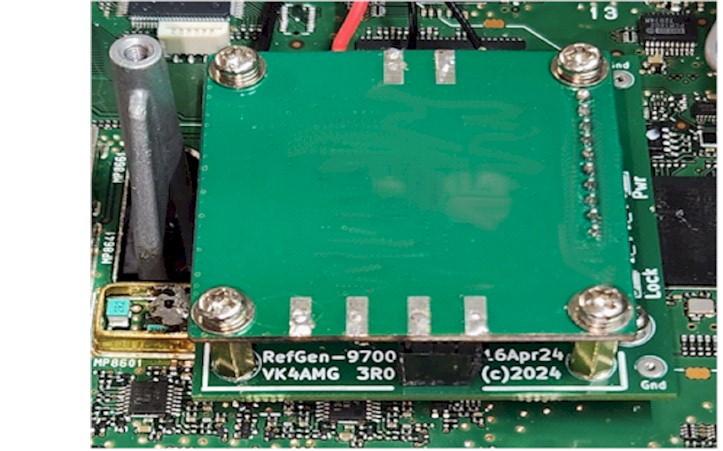
The RefGen-9700 generates and couples a strong 49.152MHz signal to the TCXO. If the TCXO is closely tuned to 49.152MHz, the frequency of the TXCO will be injection locked. The result is the radio frequency locked to five times (49.152 / 10) the specification of the 10MHz external oscillator. i.e. <5 ppb (parts per billion) for the GPSD-2. This means stability and accuracy better than +-50Hz at 1296MHz.
 VK4AMG