Enquiries to City of Brisbane Radio Society about the RefGen-9700 have triggered more explanations.
For example “I have a question regarding the operation of the reference board. Since the board is taking over the function as oscillator, I can’t work out why we are still using the onboard auto-sync function. My understanding was that the auto sync function adjustment in the software to match an external reference. Since a GPS locked source should be right on frequency, I would have thought this would make the software adjustments unnecessary.” to City of Brisbane Radio Society about the RefGen-9700 triggered more explanation.
The RefGen-9700 does not take over the “function of the oscillator”. The source of the reference 49.152MHz for the IC9700 remains the temperature compensated crystal oscillator (TCXO).
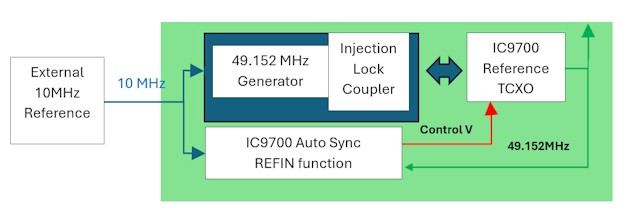
“10MHz Reference Input Function of the IC9700” shows how to connect the external 10MHz reference. “IC9700 Info (manual update)” describes the auto sync function added in IC9700 Version 1.1. This feature aimed to overcome the deficiency where the IC9700 frequency was unstable and, even though calibrated, inaccurate. The deficiency has been reported to be due to a TCXO of insufficient stability for a radio intended for 1296MHz digital modes; temperature changes of the TCXO due to ambient and radio temperature changes, fan circulated cooling air, and latency in the temperature compensation of the TCXO.
In addition to the AutoSync function, later models were fitted with a foam block over the TCXO shield. This attempted to minimise the temperature change and rate of temperature change of the TCXO. After this mod and firmware Version 1.1, many 23cm digital mode operators remained critical of the stability and accuracy of the radio. While the performance was adequate at 2m and often at 70cm, discrete steps (reported as 4Hz) have been noted during 23cm digital operation.
“RefGen-9700 Injection Locking – An Explanation” show a block diagram of IC9700, external 10MHz reference, and the RefGen-9700 injection locking module. Injection locking involves placing the TCXO in an RF field to draw the TCXO frequency to that of the injection oscillator. The RefGen-9700 uses an input of a stable and accurate 10MHz external reference and generates a low noise 49.152MHz of sufficient level to hold the IC9700 TCXO to frequency over a wide range of ambient conditions.
Many IC9700 forums were reporting many injection locking modules were difficult to setup, both in their configuration software and in adjusting the IC9700 calibration / sync correctly. Many required a stable beacon or stable signal generator to adjust the sync function and test the operation of the injection locking.
After other IC9700 products were successful in assisting users, Members of The City of Brisbane Radio society suggested I look at options to improve injection locking options. Hence the RefGen-9700 was born. After careful beta testing by non-associated technical qualified IC9700 operators, the RefGen-9700 has been released. Acceptance has been good with satisfied users world-wide.
Now to answer your question. The major difference between the RefGen-9700 and other injection locking offerings is the use of an external 10MHz refence generator (most feed 49.152 from an external generator to an injection locking coupler). In addition to the RefGen-9700 generating the 49.152MHz for injection locking, the 10MHz is fed to the REFIN of the IC9700. This allows the AutoSync feature (Firmware later than Version 1.1)to calibrate the TCXO close to the correct frequency before the injection locking is applied. By leaving the AutoSync function enabled, the radio continually checks the frequency of the TCXO and if (unlikely as it is) the TCXO moves outside the lock range of the RefGen-9700, the AutoSync will recalibrate the TCXO into the lock range of the RefGen-9700. Each time the radio is switch-on the AutoSync does its thing before the injection locking is activated. This assists calibration for changes in the radios operating environment.
I’d expect that the AutoSync is unnecessary after initial setup and validation. As explained above, the function does not degrade the injection locking but avoids the complicated setup required by other injection locking offerings and ensures the RefGen-9700 holds the accuracy and stability under all operating conditions.
Whether you leave the AutoSync enabled is up to you. AutoSync does provide a reliable indication that the external 10MHz reference is connected, is operating, and is close to frequency. I have not tested the alarm range of “external 10Mhz not available” but it does detect a 10Mhz reference that hasn’t been allowed to warmup before the IC9700 is switched on.
For this reason, I recommend the external 10MHz external reference is continuously powered. The matching CBRS GPSD-2 10MHz GPS Disciplined Reference Generator draws less than 500mA, typically 150mA, at 12V dc.
Warm-up is less than 2 minutes. As stated above, the DGPS-2 needs to be warmed up (two green LEDs) prior to the IC9700 being switch-on. If not, the Auto sync will “spit the dummy”. You may then elect not to enable that function after initial calibration. The RefGen-9700 will then force the IC9700 to track the settling 10MHz external reference during warmup of the radio and the reference generator.
 VK4AMG